
Home / History / Silk and the canuts
Silk and the canuts
Lyon has been a major silk centre since the 15th century. The canuts, the city's silk weavers, rose up in 1831 and again in 1834 to obtain a minimum rate.
An industry ordered by the king
In 1466 Louis XI decided to make silk in Lyon to limit purchases of foreign cloth. Activity took off from 1536, when Francis I allowed a Piedmontese living in Lyon to weave gold, silver and silk. A royal monopoly then protected the market.
A royal and imperial craft
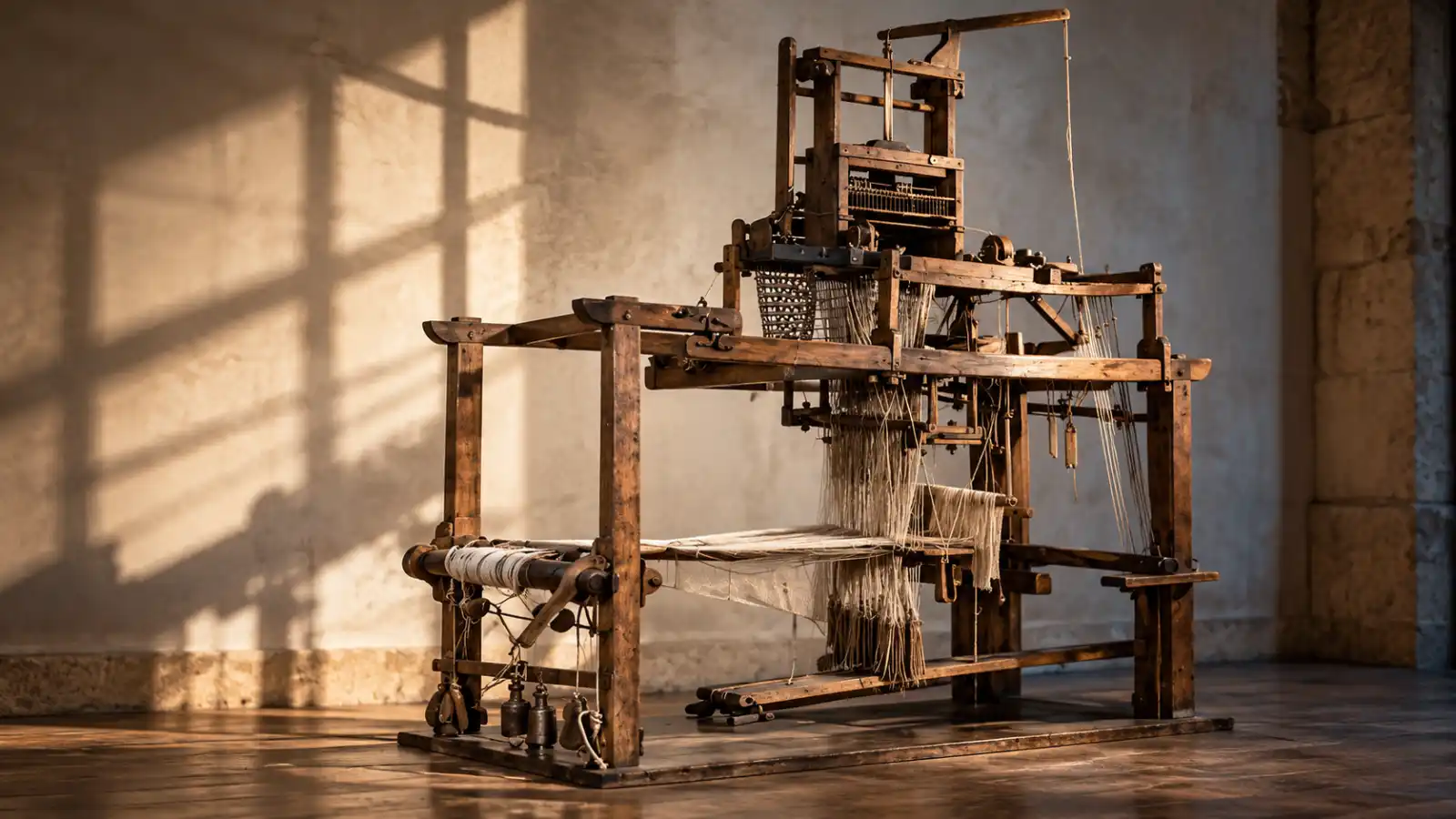
Louis XIV ordered brocades for Versailles, the courts of Europe followed, and Napoleon revived the workshops after the Revolution. Looms improved thanks to Vaucanson (1740s) and then Jacquard, who patented his mechanism in 1804.

Colbert, Olivier de Serres and the courts of Europe
Under Henri IV, Olivier de Serres' work made it possible to raise silkworms in south-eastern France. In the 17th century, workshops, mostly on the Presqu'île, wove plain fabrics; in 1667 Colbert regulated production by fixing fabric widths and thread counts. Courts across Europe placed orders: Lyon wove for Catherine II of Russia, Spanish royal residences and the King of Sweden.
The canuts and their revolts
Despite the silk trade's prosperity, the canuts lived in poverty, with 16-hour days and long spells of unemployment. In November 1831 they rose up, shouting “Live free working or die fighting”. Troops put down the movement. A second uprising followed three years later.
Silk today
Few silk houses remain, now focused on haute couture and furnishings, but Lyon keeps its textile image. To see: the Maison des Canuts and the Mur des Canuts on the Croix-Rousse plateau, the traboules of the slopes, and the Museum of Textiles and Decorative Arts on the Presqu'île.
Frequently asked questions
What is a canut?
A silk weaver working in Lyon, especially in the Croix-Rousse.
When were the canuts' revolts?
In November 1831 and in 1834.
 Old Lyon and its traboules
 Bouchons and specialities of Lyonnaise cuisine
Updated 25 October 2026.